


|

 |
|
|||||||


| Books and Magazines Topics related to WWI aviation authors, books and magazines -- Link to Aeronaut Books |
 |
|
|
Thread Tools | Display Modes |
 10 January 2022, 01:31 PM
|
#1 |
|
Observer
Join Date: Jan 2022
Posts: 1
 |
 New Book - Diary of Howard Rath - 96th Squadron
For military historians and enthusiasts, “First to Bomb - The World War I Diary of Lt. Howard G. Rath, Bombardier, 96th Aero Squadron” is fascinating reading. Author/historian Hugh T. Harrington has transcribed the previously unpublished diary of Lt. Howard G. Rath into a captivating chronological scenario telling the story of Rath and his 96th Aero Squadron stationed on French soil at Amanty. Most notably history records Rath, as lead observer and bombardier, with the distinction of making the first WWI bombing missions against “Bosche” or “Hun” targets on June 12, 1918.
The book also describes Rath’s future bombing missions and targets until war’s end on Monday, Nov. 11, 1918. Rath’s diary was meant only for himself, so many of the incidents and facts laid out in its pages are fascinating and were totally unsanitized. The diary also opened many day-to-day incidents to me that one never hears of from other published early aviation sources. The book offers insights into Rath’s crossing of the Atlantic Ocean dodging German submarines and quirky fellow soldiers. It also describes the wide presence of the American Red Cross and YMCA personnel in France which I had not aware of. Learning that labeling a cloudy and rainy day as a “dud day” was a colorful phrase used 100 years ago. A completely intriguing fact I learned was that while flying their Breguet 14 B2 biplanes, the observer/bombardier sitting behind the pilot saw the approaching target through a “slot in the floor” and steered the pilot by using “reins attached to the pilot’s shoulders”. The observer/bombardier would then fire a pistol to signal the rest of the squadron to ready their bomb drop; far from the precision digital accuracy of bombing today. Breaking propellers in the deep mud at takeoff was a constant danger, as was frostbite on Rath’s “nose, chin, and cheeks” which had already turned black. However as in any war, Rath’s diary also documents the horrible side of fighting, grieving and death. Scenes as Rath standing watch on the flight field for returning “machines” (aeroplanes) piloted by fellow aviators, only to realize none were coming back. “Spent all day packing up Joe Mellen’s effects”, Rath sadly wrote. In a day when aviators had no parachutes, Rath recorded such scenes as “Gundy was seen to jump from the plane but Penn stayed in and was burned”. Major Thomas Dewitt Milling reflected the feeling of Rath’s squadron as “during the Battle of St. Mihiel we had terrific losses in our day bombardment… the morale of the group itself was very low.” A specifically helpful aspect of the book are author Hugh Harrington’s brief interjections at certain spots in the narrative. In identifiable italics Harrington goes into background depth on certain subjects like the Vickers and Lewis guns, and the 7th A.I.C. Bomb Sight There are many other absorbing stories which appear in this first-time published book. I found the entire diary-book very enticing reading. 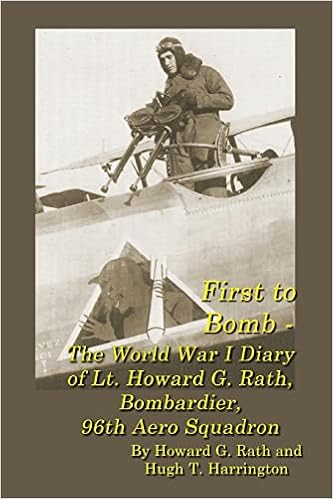
|

|
| Sponsored Links |
|
|
|
10 January 2022, 02:37 PM
|
#2 |
|
Forum Ace of Aces

Join Date: Aug 2001
Location: St. Charles, Iowa
Posts: 6,724
|
I would second all of CaptainJohnSmith's recommendations. This is a very important book! The author, Hugh Harrington, is a member of this forum, and announced its publication here.
http://www.theaerodrome.com/forum/sh...ad.php?t=74403
__________________
Greg VanWyngarden An expert is a person who has made all the mistakes that can be made in a very narrow field. Niels Bohr |
|
|
|
10 January 2022, 05:00 PM
|
#3 |
|
Observer

Join Date: Jun 2018
Location: Georgia USA
Posts: 66
 |
Thank you Greg. I put a whole lot of time and effort into this project and it means a great deal to me to read your comments. Thank you.
__________________
Hugh T. Harrington Author: "First to Bomb The World War I Diary of Lt. Howard G. Rath, Bombardier, 96th Aero Squadron." Available worldwide through Amazon Author: "Destiny's Wings, Four Months in Day Bombardment: The Story of Hugh S. Thompson, 96th Aero Squadron, U.S. Army Air Service in World War I." Available worldwide through Amazon. |
|
|
|
13 January 2022, 11:21 AM
|
#4 |
|
Forum Ace of Aces

Join Date: Aug 2001
Location: 5 minutes (on foot) from GAAM in Penna.
Posts: 3,115
 |
More important than it appears
This book is a perfect follow-on the Hughs previously published Destiny’s Wings: Four Months in Day Bombardment: The Story of Lt. Hugh S. Thompson, 96th Aero Squadron, U.S. Army Air Service in World War *and* his excellent article in OTF Vol 26 #1, Spring 2021 "We Were Told What to Write".
The transcription is important because it is from a career civilian - not a military professional - who was pressed/volunteered into service and as such it is unfiltered. There is no quarter given to the larger military machinery - no excuses offered simply because "that's the way the military works" - just Rath speaking his mind, pointing out the foolishness of decisions and the subsequent cost in lives. What Hugh as not pointed out here is that this diary was extraordinarily difficult to read - Rath's handwriting was almost as indecipherable as the Rosetta Stone, but he was able to transcribe it all and for that effort alone he should be lauded. It will never be a best seller, but it is, in my opinion, an extraordinarily important piece of work that provides an unsanitized view into the operations of the US 1st Day Bombardment Group and in some context, the USAS in general. Available on Amazon.
__________________
 Join the League of World War One Aviation Historians - and receive 4 issues of "Over the Front". Visit us at : http://overthefront.com/ And be sure to visit - Visit www.goldenageair.org |
|
|
|
| Bookmarks |


«
Previous Thread
|
Next Thread
»
 Linear Mode

|
|

 Similar Threads
|
||||
| Thread | Thread Starter | Forum | Replies | Last Post |
| NEW - "First to Bomb the WWI Diary of Lt. Howard G. Rath | historyguy | Books and Magazines | 0 | 30 November 2021 12:28 PM |
| Found Diary of Lt. Howard G. Rath - 96th Aero Sq. | historyguy | Books and Magazines | 12 | 19 February 2020 07:40 AM |
| Diary of Howard J. Rath, 96th aero Sq. - trying to locate | historyguy | Books and Magazines | 11 | 23 July 2018 03:27 AM |
| Lt. J.C. Earle Maclennan 96th Aero Squadron | Joe Jordan | People | 8 | 25 December 2010 04:59 PM |
| 96th aero squadron ww1 | lbaltn | 2002 | 1 | 24 March 2002 05:56 PM |
As an Amazon Associate we earn from qualifying purchases.
All times are GMT -7. The time now is 03:32 PM.